

Read in

Table of contents
When trading internationally, it's important to understand the various Incoterms® that govern liability and costs between buyer and seller.
DDP is one of the most comprehensive of these — with a clear division of responsibility that places almost all costs and risks firmly on the seller's side.
What does DDP mean?
DDP stands for Delivered Duty Paid, and it is one of the most comprehensive Incoterms®. Under DDP, the seller takes on almost all costs and risks involved in getting the goods to the buyer — including shipping, insurance, customs clearance and any import duties.
Dette inkluderer fragt, forsikringer, toldbehandling og eventuelle importafgifter.
By the time the goods reach the buyer, everything has been paid for. The buyer simply receives the delivery with no further obligations.
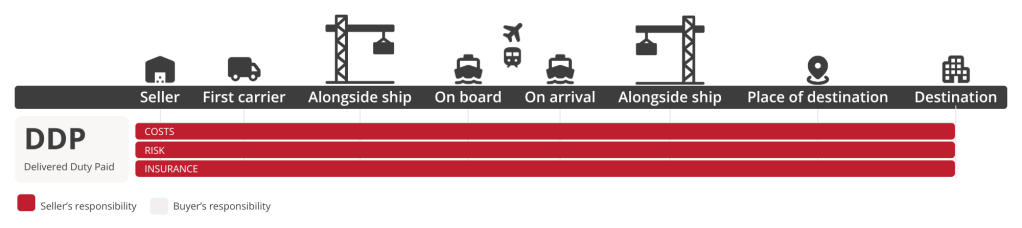
Responsibilities under DDP
Under DDP, the seller carries primary responsibility for transport and all costs associated with delivering the goods. The buyer's only obligation is to receive them.
The seller is responsible for:
- Transport costs — covering all shipping and freight, both domestically and internationally, until the goods reach the buyer, including booking and payment of transport
- Customs duties and taxes — paying all export and import duties and any other applicable charges
- Risk — bearing responsibility for any loss or damage to the goods during transit
The buyer is responsible for:
- Receiving the goods at the agreed delivery destination and confirming they are in good condition
- Any issues with the goods that arise after delivery and are unrelated to transport
To learn how DDP compares to other Incoterms® such as FOB, CIF and EXW, check out our full overview of Incoterms® 2020.
Pros and cons of DDP for the seller
Pros:
- Full control over the entire delivery process, which can lead to more efficient and reliable outcomes
- Ability to offer a premium, all-inclusive service — appealing to buyers who want a simple, hassle-free experience
Cons:
- The seller bears the full risk of transport and any additional costs that arise during transit
- Handling customs clearance and import formalities in the buyer's country can be time-consuming and requires local expertise
Pros and cons of DDP for the buyer
Pros:
- No need to worry about transport, customs or additional charges — the seller handles everything
- Full cost transparency from the outset, as all expenses are already factored into the price
Cons:
- Since the seller absorbs all costs, the price paid by the buyer is typically higher than under Incoterms® where the buyer manages some logistics themselves
- The buyer is entirely dependent on the seller's ability to handle transport and customs clearance correctly
To sum up
DDP is an excellent option for buyers who want a straightforward transaction — no transport to arrange, no customs to handle, no surprise costs.
For sellers, it's an opportunity to offer a premium, end-to-end service. The trade-off is taking on greater responsibility and higher costs throughout the delivery process.
Get a full overview of responsibilities under all Incoterms® 2020..
Frequently asked questions about DDP (Delivered Duty Paid)
What does DDP mean?
DDP stands for Delivered Duty Paid — an Incoterm® where the seller takes on almost all costs and risks involved in transporting and delivering goods to the agreed destination. This covers freight, insurance and the payment of both export and import duties.
What is DAP Incoterm®?
DAP stands for Delivered At Place and means the seller is responsible for transporting and delivering the goods to an agreed destination. However, the buyer handles customs clearance and pays any import duties upon arrival.
What does DDP delivery mean?
DDP delivery means the seller is responsible for all costs and risks until the goods arrive at the agreed destination. This includes freight, insurance and all applicable customs duties — so the buyer has no further obligations upon delivery.
What is the difference between DDP and DAP?
The key difference is who pays import duties and taxes. Under DDP, the seller covers everything — including import costs. Under DAP, those costs fall to the buyer.
In practice, DDP offers the buyer a more hands-off experience, while DAP requires the buyer to handle some of the administrative work involved in importing.
How does DDP work in Denmark?
In Denmark, DDP works the same as anywhere else. If a seller ships goods to a buyer in Denmark under DDP terms, the seller is responsible for all transport, insurance and applicable duties — including Danish VAT and customs charges — right up until the goods are delivered.