


Read in

Table of contents
1 January 2025 the Danish road tax came into force - a new and significant additional cost that will be felt.
In the following, we'll go through what road tax is, who it applies to and how it can affect your freight costs in domestic road transport, international road transport and parcel distribution.
What is Danish Road Tax and how is it calculated?
Danish Road Tax is a kilometre-based tax for lorries on 12 tonnes or moreused for freight transport. The tax varies depending on:
- CO₂ emission class
- Weight of the truck
- Driving in environmental zones
CO2 emission class
The Danish Motor Agency has divided Danish trucks over 12 tonnes into 5 CO₂ emission classes Based on:
-
- Fuel type
- Fuel type
-
- Registration date
- Registration date
-
- CO₂ emissions per kilometre
- CO₂ emissions per kilometre
-
- Vehicle group and possibly subgroup
- Vehicle group and possibly subgroup
-
- Cabin type
- Cabin type
-
- Engine power
Lorries in Class 1 emits the most CO₂, while Class 5 includes zero-emission lorries.
The lower the emission class, the more the truck emits and the higher the road tax paid per kilometre.
You can find your truck's emission class in the DMR or read more about the 5 CO2 emission classes at vejafgiter.dk.
Weight of goods
The tax also depends on the truck's technically permissible total weight.
Here they are divided into 3 classes:
- Over 32,000 kg
- 12,000 to 17,999 kg
- 18,000 to 32,000 kg
The heavier the truck, the higher the tax per kilometre.
Environmental zone
Environmental zones are areas where citizens are particularly exposed to noise and air pollution from lorries.
Driving in an environmental zone can mean a up to 50% higher road tax.
Environmental zones can be found in:
- Aalborg
- Copenhagen, Denmark
- Frederiksberg
- Odense
- Aarhus
What does Danish Road Tax cost?
The price per kilometre is dependent on the three factors above.
Below are a few examples from vejafgifter.dk's website, where you can also find an overview of all prices.
The lowest cost per kilometre will be for a 12,000-17,999 kg truck in CO₂ emission class 5:
- Outside an environmental zone: 0.13 kr./km
- In environmental zone: 0.20 kr./km
The highest price will be for a truck over 32,000kg in CO₂ emission class 1:
- Outside an environmental zone: 1.10 kr./km
- In environmental zone: 1.65 kr./km
The tax per kilometre will therefore vary considerably from truck to truck and whether or not they are driving in an environmental zone.
How does road tax affect your freight costs?
It is the hauliers who have to pay Danish Road Tax, as it is their lorries that drive on the roads. However, they will include this extra cost in the freight prices to their customers.
How carriers choose to account for this additional cost varies, and the impact of their method will be different.
The effect of road tax on different transport areas
Several carriers have announced the calculation method and the percentages or amounts they will use to settle the road tax.
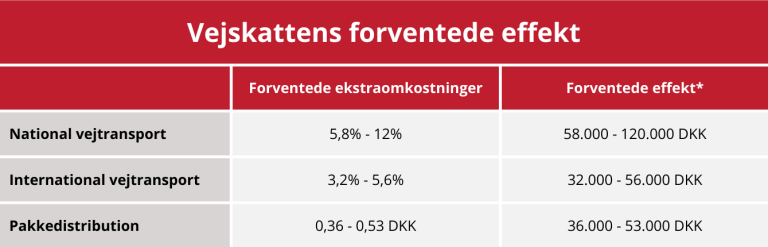
Based on their written statements, we have calculated the expected impact of road tax for 2025.
Our starting point is a company that buys freight worth DKK 1 million annually.
Below you can see what the effect will be for national road transport, international road transport and parcel distribution. We will then elaborate on the individual modes of transport and their calculation methods.
National road transport
For national road transport, hauliers use very different methods to settle road tax.
Some use a percentage rate, while others charge a price per 100kg with minimum and maximum prices.
Some carriers also divide Denmark into zones with different prices/percentages, while others consider Denmark as one single zone.
The effect of Danish Road Tax on national road transport
The highest price will be for a truck over 32,000kg in CO₂ emission class 1:
- Outside an environmental zone: 1.10 kr./km
- In environmental zone: 1.65 kr./km

International road transport
For international road transport, there is greater agreement on how road tax should be settled.
Here, most carriers choose to charge a price per 100kg with minimum and maximum prices.
The biggest difference from carrier to carrier is whether destinations are divided into zones per country or into multiple zones within the same country - as we know from the German Maut.
The effect of Danish Road Tax on international road transport
Overall, Danish Road Tax will lead to an increase in freight costs of between 3.2% and 5.6% on international vet transport.
If you have an annual freight budget of DKK 1 million, this means an additional cost of DKK 32,000 to DKK 56,000.

Parcel distribution
For parcel distribution, carriers' methods of settling road tax vary widely.
Some charge a flat fee per package, while others choose a percentage.
NOTE: For some carriers, the road tax may instead be included in the oil surcharge (energy surcharge). In this case, the oil surcharge will increase - for example by 2%.
The effect of Danish Road Tax on parcel distribution
The surcharge for Danish Road Tax will be between 0.36 kr. and 0.53 kr. per pack.
If you send 100,000 packagesthis corresponds to additional costs of between DKK 36,000 and DKK 53,000.

Oil surcharge
It has been seen in the past that oil surcharges have been levied on other surcharges.
The oil surcharge is calculated as a percentage, which means that if a surcharge is included, you end up paying more than what the surcharge originally appears on the invoice.
However, in the above calculations we have Assumed that carriers do not charge oil surcharges on road tax.
This assumption is based on the fact that several carriers have explicitly stated that they will not include road tax in the oil surcharge. We therefore expect this to become the norm.
Road tax will be most expensive on smaller consignments
cost to you than the previously mentioned figures.
Smaller shipments can be:
- Half pallets
- Quarter pallets
- Single pallets
This is because several carriers have a minimum price for the Road Tax surcharge.
Therefore, if many of your shipments fall under this minimum price, the surcharge may end up being a larger percentage than the previously mentioned figures.
Example: If a carrier's minimum price is 17 kr. on national road transportand your shipping price is 100 kr.you end up paying 117 kr. for the freight.
Here, the road tax surcharge will therefore provide 17% in additional cost rather than the otherwise expected 5-12%.
For a smaller number of shipments, this doesn't make a big difference, but If a large proportion of your shipments are small consignments, road tax can quickly become a major expense.
Road tax as a competitive parameter
The large differences in how hauliers pay road tax means that road tax becomes a competitive parameter.
But this is problematic in our eyes.
After all, billing "should" be more or less the same.
Unfortunately, this is not possible due to the complexity of re-invoicing.
Settlement in kilometre price
Danish Road Tax is calculated as a price per kilometre travelled, while road transport is usually settled in loading metres, cubic metres, kilos, pallets, etc.
Carriers must therefore convert the price per kilometre into weight or volume, which is a difficult task with many factors at play.
Depending on the location of the carrier
Another part of the complexity is that road tax depends on the location of the haulier.
Road tax must be paid for all driving on the roads in question.
Example: A carrier from Herning will pick up goods in Aalborg and deliver them in Skagen.
The lorry will drive the Herning-Aalborg-Skagen route, and Danish Road Tax must be paid for the entire distance.
But who pays for the distance from Herning to Aalborg? These costs must also be included.
Therefore, the location of the carrier has a significant impact on the final price
Not the carrier's fault
It's important to emphasise that this is not the carrier's fault.
The problem arises because road tax is calculated based on kilometres, while carriers typically charge freight by pallets, cbm, ldm or kilos.
It is therefore a Challenge to convert kilometre distance to volumeas many factors come into play.
Conclusion and recommendations
You can expect higher freight costs in 2025. Danish Road Tax will represent a significant additional cost.
But as mentioned in this infomail at the same time, many other factors are also pushing up freight costs. It is therefore important to be aware of this in 2025.
We recommend that you compare prices in Q1 2025 and reviews all parameters thoroughly. With a road tax of 5% with one carrier and 12% with anotherthe difference can quickly become noticeable on your bottom line. And then you risk paying unnecessarily.
If you have any questions, please feel free to reach out.
Otherwise you can always Follow us on our infomail, where we share the most important news about freight and logistics and how it affects your freight costs.
Hope to see you there!
FAQ
What is Danish Road Tax and who does it apply to?
Danish Road Tax is a kilometre-based tax that came into effect on 1 January 2025. It applies to trucks of 12 tonnes or more used for freight transport. The tax is calculated based on the lorry's CO₂ emission class, weight and driving in environmental zones.
How does Danish Road Tax affect freight costs?
Danish Road Tax will be included in freight prices, which can lead to increased costs for both national and international road transport and parcel distribution. The amount of the increase depends on the carriers' calculation methods and the specific circumstances of your freight.
What does Danish Road Tax cost per kilometre?
The price varies. The lowest price is €0.13/km for a light truck (12-18 tonnes) in CO₂ emission class 5 outside environmental zones. The highest price is £1.65/km for a heavy truck (over 32 tonnes) in class 1 within environmental zones.
What are environmental zones and how do they affect road tax?
Environmental zones are areas with high exposure to noise and air pollution found in major cities such as Copenhagen, Odense and Aarhus. Driving in an environmental zone can increase road tax by up to 50%.
How can companies prepare for Danish Road Tax?
Businesses should analyse their freight patterns and compare carrier rates in Q1 2025. Differences in road tax calculation can have a significant impact on freight budgets, especially for smaller shipments.