

Read in

Table of contents
Choose the right offer type
It's important that you choose the right type of offer for your goods. The type of goods has a big impact on which type of offer is most ideal for your logistics.
There are great savings/optimisations to be made by choosing the correct quotation form. Quotation types include cbm, ldm, pll, kg, etc.
If your pallets are not always standard dimensions, it's especially important to be aware when choosing a pallet offer, as you may risk being charged for multiple pallets if the goods go beyond the pallet
What is conversion factor?
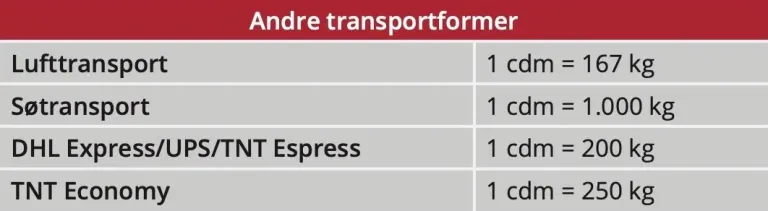
The conversion factor is used to convert volume to volume weight. The conversion factor tells you how many kilograms go into, for example, 1 cbm or ldm.
The conversion factor doesn't have a big impact on goods with a high density (i.e. the goods weigh more than they take up). However, if you have goods with a low density, we have seen examples where different conversion factors change more than 5% of the cost.

Pay attention to your charge metre calculation
Loading metres are calculated as Length (M) x Width (M) / 2.4. Agree with your carrier how to calculate the loading metres for pallets that do not have the standard width of 80 cm. There is no general rule for how to calculate the loading metre for non-standard pallets.
For example, if you have a pallet measuring 200 cm x 200 cm, the direct loading metre calculation would be 2 x 2/2.4 = 1.7 ldm.
In practical terms, however, your pallet in the truck will only have 40cm left to float the full width of the vehicle. In this case, some carriers will argue that you should pay for the full width, so the loading metre becomes 2 x 2.4/2.4 = 2 ldm.

If you want to read more about Ladmeter, we've written about it here Calculating the load metre.
Save money with benefit calculation
The rate price decreases as the shipment size increases, and here the decrease can be so large that it will be cheaper to send a larger parcel.
For example, the rate for 500 - 699 kg may be DKK 129 per 100 kg, while the rate for 700 - 999 kg is DKK 79 per 100 kg.
A shipment of 600 kg will therefore cost 774 DKK, while a shipment of 700 kg will cost 553 DKK. You will therefore save DKK 221 by sending a 100 kg heavier shipment.
With benefit calculation, your carrier will round up to the next instalment if there is money to save, as in the example above.
Read more about What benefit calculation is and how you can get it.
Make your considerations for multiple carriers
When comparing prices, among other things, it's important to "price" the time and administration of having multiple carriers. Multiple carriers often means that the following points need to be done for more than one carrier:
- Loading/unloading
- Booking
- Relationship building
- Invoice Audit
- Administration
- Contracting and maintenance
However, the advantage of having multiple carriers is that you can have specialists in each country, mode of transport or area. We therefore encourage you to evaluate the advantages/disadvantages of having 1 or more carriers.
Remember the soft values
Besides the freight price, it's important to look at the soft values of carriers. The right carrier can boost your logistics and ultimately your company's competitiveness. Soft values include
- Loading/unloading times
- Departure frequencies
- Transit time
- Booking and document flow
- IT
- Booking deadline
- Relationship
- Payment terms
Difficult to compare offers?
Unfortunately, comparing different freight offers and managing a tender process can be difficult and cumbersome.
Therefore, we would like to help you compare your freight offers so that you can choose the right solution for you and your logistics setup. The choice is entirely yours, and we do not share in any potential savings.