

Read in

Table of contents
A tender process doesn't have to be complicated.
The most important thing is that you make sure that Get the right freight setup for your needs.
During your tender, you should therefore make sure to clarify and align expectations with the selected carriers. This will ensure that you get the best possible collaboration.
In the following, you will learn what a tender process looks like and what six steps it consists of.
The six steps of a freight tender
The process of a tender can be divided into six steps. These steps include thorough preparatory work, the tendering round, comparing offers and, finally, negotiations or a possible new tendering round.
After that, you can start working with a new carrier or continue working with your current carrier with the new freight agreement.
The six steps of the tender process are illustrated below.
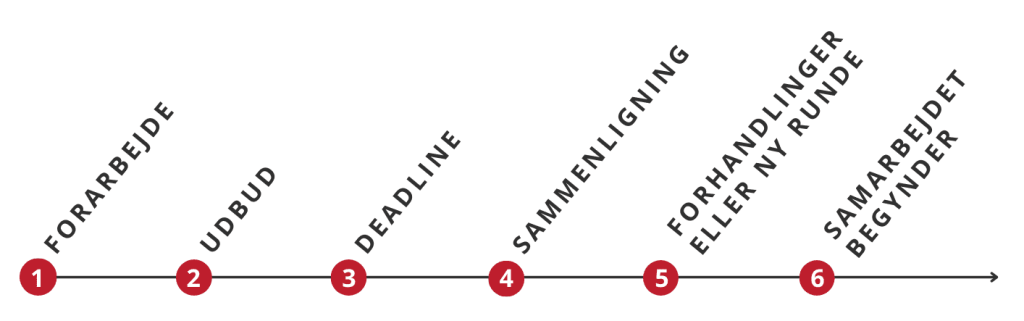
By investing time and resources in the process, you can get the most out of your tender. Finding the best freight deal for your needs not only ensures you get the right freight mix, but can also help to Reduce costs, improve customer experience and strengthen your supply chain as a whole.
Step 1: Preparation
Before you can get quotes from carriers, it's important to do the basic preparation. This involves Collect statistics on your shipments, prepare a tender letter and create a tender checklist. In addition, the carriers to be included in the tender must also be selected.
Shipment statistics
First of all, you need to collect yearly statistics of the shipments you want to offer in your tender.
Statistics can include data such as number, volume, weight, recipient and sender postcode.
Tender letter
Once you've gathered your shipment statistics, it's time to prepare your tender letter.
A tender letter is the letter you send to the selected carriers to request quotes.
A tender letter should include what you want to quote for and how your freight set-up fits together. In the tender letter you should therefore include your shipping setup, pictures of your typical shipments and other special conditionsthat affect your freight agreement and co-operation.
Tender checklist
A tender checklist is an extension of your tender letter that you send with the tender letter and your shipment statistics.
The trend checklist can be used to Get an overview of the soft values so you can compare carriers on the same basis and not just look at their prices.
It can include points such as:
- Benefit calculation
- Transit times
- Deadlines
- System compatibility
- Track and Trace
Not sure what benefit calculation is and why you should include it in your shipping agreement? Then read about benefit calculation here.
Select carriers
The last step before sending your tender letter, checklist and shipment statistics is to select which carriers you want to send it out to.
Putting the necessary basic preparation into your tender will give you the best possible starting point to achieve Competitive offers and find it The right carrier for your shipping needs.
To learn more about the entire tender process and see examples of a tender letter and tender checklist, read our large guide to your tender process.
Step 2: Tendering
In step 2 you send your shipment statistics, tender letters and tender checklist off to the selected carriers.
You decide how long you give the carriers to respond, but We recommend giving them three weeks to respond to the offer and get back to us.
Step 3: Deadline
Deadline for carriers to bid on your offer, so all offers must now be received.
We recommend that between step 2 and step 3 you give the carriers the opportunity to visit the company and ask any questions. This gives carriers a chance to get a better understanding of your needs and requirements and to clarify any points of doubt.
These visits can be a valuable opportunity to get the necessary information and ensure all parties are on the same page.
Step 4: Comparison
In step 4, the incoming offers are compared against your shipment statistics. In addition, the carriers' completed quote checklists are also compared to include the soft values in your decision-making process.
By comparing offers not only on price, but also the offer checklist of the soft values that are important to you, you will Easier for you to choose the right offer for your specific needs and freight setup.
Compare offers correctly
However, comparing shipping rates can be Difficult and opaqueas virtually no two carriers are alike when it comes to offer structure, service and values.
Therefore, when comparing offers, it's important to do so on the same basis, so you're not comparing apples and oranges, but apples to apples.
When comparing shipping rates, make sure you include all fees and don't just look at the shipping rates. Fees make up a significant part of the total price of a shipment.
It's important to include all fees, as this often changes which carrier is the cheapest.
Step 5: Negotiation or new round
Based on the comparison in step 4, the second final step in the tender process is to negotiate with the selected carrier(s), or a new tender round can be initiated where the carrier can make small adjustments to their offer.
In this step, it's important to use the data from the comparison in step 4 to ensure that carriers are aware of which ranges, zones and countries they should reduce prices in.
Step 6: Collaboration begins
Once you have signed the new agreement, you can start working with the carrier or continue your previous collaboration with the same carrier with the new agreement.
How long does a tender take?
Although the duration of a trend can vary depending on different factors, it is typical to say that it can take between 2.5 to 3 months.
This timeframe gives you enough time to advertise your tender, select potential carriers, collect offers and evaluate them.
The duration of your tender process can depend on how long you give the selected carriers to return with a quote, how long it takes you to compare their quotes and how many tender rounds you choose to go through.