


Read in

Table of contents
EXW (Ex Works) is one of the most widely used and fundamental Incoterms®. Under this Incoterm®, almost all responsibility for transport and risk falls on the buyer, while the seller's obligations are kept to a minimum.
What does EXW mean?
EXW stands for Ex Works and means the seller's responsibility ends once the goods are ready for collection at the seller's premises. From that point, the buyer takes on full responsibility — including transport, insurance and customs clearance.
For the seller, EXW is a straightforward arrangement: pack the goods and have them ready at the agreed location. For the buyer, it offers full control over transport — but it does require experience with international freight.
Example: If a Danish seller supplies goods to a customer in Sweden under EXW terms, the buyer must arrange transport from Denmark to Sweden, cover export duties and handle customs clearance on the Swedish side.
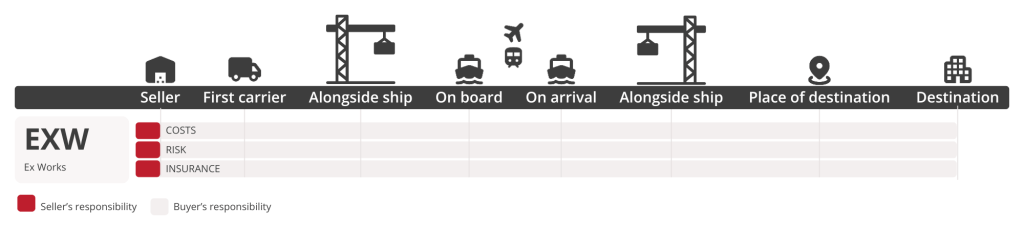
Responsibility under EXW
Under EXW, all responsibility transfers from seller to buyer the moment the goods are made available — whether that's at the seller's factory, warehouse or another agreed location.
The seller is responsible for:
- Having the goods ready at the agreed location on time
- Ensuring correct and appropriate packaging
- Meeting the agreed handover terms and delivery schedule
NOTE: The seller's responsibility ends the moment the goods are on board. From that point, all risk passes to the buyer — including any damage or loss during the voyage.
The buyer is responsible for:
- Arranging all transport
- Paying customs duties and taxes in both the country of origin and the destination country
- Bearing all risk from the moment the goods are collected from the seller
To learn how EXW compares to other Incoterms® such as FOB, CIF and DDP, check out our full overview of Incoterms® 2020.
Pros and cons of EXW for the seller
Pros:
- Minimal risk and responsibility — no involvement in transport or insurance once the goods are ready
- Lower administrative burden, with no logistics costs to manage
- Frees up time and resources to focus on production and quality
Cons:
- If the buyer fails to collect on time, the seller may incur additional storage costs
Pros and cons of EXW for the buyer
Pros:
- Full control over transport — the buyer can choose the shipping methods and logistics partners that best suit their needs
- Potential for cost savings by negotiating directly with carriers
- High flexibility to optimise the logistics process using the buyer's own partners and expertise
Cons:
- The buyer takes on all complex tasks — including customs clearance, full transport coordination and all risk of damage or loss from the moment the goods leave the seller's premises
NOTE: EXW can be challenging for smaller businesses or buyers new to international trade, as it requires coordinating every aspect of transport and customs clearance independently.
To sum up
EXW is the right choice when the seller wants minimal involvement in transport and logistics, and the buyer has the experience and resources to take on full responsibility for freight and risk.
Get a full overview of responsibilities under all Incoterms® 2020..
Frequently asked questions about Incoterms®
What does Ex Works mean?
Ex Works (EXW) is an Incoterm® where the seller's responsibility ends once the goods are ready for collection at the seller's premises — such as a factory or warehouse. From that point, the buyer takes on all responsibility for transport, insurance and customs clearance.
What does EXW Incoterm® 2020 mean?
Under EXW (Ex Works) in Incoterms® 2020, the seller is only responsible for making the goods available for collection at their premises. All responsibility for transport and risk passes to the buyer from that moment onwards.
What do EXW delivery terms mean?
EXW delivery terms mean the seller is only required to make the goods available for collection at their own location. Everything beyond that — transport, customs clearance and insurance — is the buyer's responsibility from the moment the goods are ready.
What is the difference between EXW and FOB Incoterms®?
Under EXW, almost all responsibility sits with the buyer — they arrange transport and bear all risk from the moment the goods are picked up at the seller's premises.
Under FOB (Free On Board), the seller is responsible for getting the goods to the port and having them loaded onto the vessel. Risk and responsibility then transfer to the buyer. FOB therefore places more obligation on the seller than EXW does.
What is the difference between FCA and EXW?
The key difference is where the seller's responsibility ends. Under FCA, the seller delivers the goods to a carrier nominated by the buyer.
Under EXW, the seller's only obligation is to make the goods available at their own premises — the buyer handles everything from there, including arranging collection and transport.