


Read in

Table of contents
What is a conversion factor?
A conversion factor is used to convert volume — such as cubic metres (CBM) or loading metres (LDM) — into weight,so that transport costs can be calculated.
It indicates how many kilograms correspond to one CBM or LDM of goods.
For high-density goods — where the shipment weighs more than it takes up space — the conversion factor has little impact. But it becomes particularly important for low-density goods, where volume is the dominant factor rather than weight.
We've seen cases where different conversion factors have shifted transport costs by more than 5%.
Conversion factors by mode of transport
Conversion factors vary depending on the mode of transport. Nedenfor er nogle eksempler på omregningsfaktorer for forskellige transportformer.
Below are some common examples — but always check which factor your carrier applies, as it can differ by both transport mode and carrier.
It's also worth noting that your carrier may not charge per loading metre, EUR pallet or cubic metre at all. Some have their own factors, or charge per parcel or shipment instead.
Road transport
Conversion factors for road transport are based on load capacity, which can vary significantly from market to market..
Here's a general overview by region:
| Road transport | Denmark | International | NO/SE/FI |
|---|---|---|---|
| 1 Loading metre = | 1,500 kg | 1,850 kg | 2,000 kg |
| 1 Cubic metre = | 250kg | 333 kg | 350kg |
| 1 EUR pallet* = | 600kg | 740kg | 800kg |
*One EUR pallet corresponds to 80×120 cm.
If you're unsure how to calculate loading metres, check out our guide on how to calculate loading metres.
How to calculate volume in cubic metres is covered further down the page.
Courier transport
The conversion factor for courier transport varies considerably depending on the carrier.
Here are some examples for specific carriers and shipment types:
NOTE: Always check with your carrier — conversion factors can differ between shipment types.
| DHL Express | 1 CBM = 200 kg |
| UPS | 1 CBM = 200 kg |
| TNT Express | 1 CBM = 200 kg |
| TNT Economy | 1 CBM = 250 kg |
How to calculate the volume of your shipment in cubic metres is covered further down the page.
Air freight
Air freight capacity is more weight-restricted than sea freight, for example, which is why the conversion factor for air transport tends to be lower than for other modes.
A typical conversion factor for air freight is 1 CBM = 166.67 kg.
Sea freight
There is often no fixed conversion factor for sea freight— instead, shipments are typically priced per unit or per cubic metre.
Where a conversion factor is used, it is usually 1 CBM = 1,000 kg.
Rail transport
Most rail carriers use their own conversion factors, and there is no established industry standard.
Always check with your carrier to find out which factor they apply.
Complete overview
Here's a full overview of conversion factors across all modes of transport:
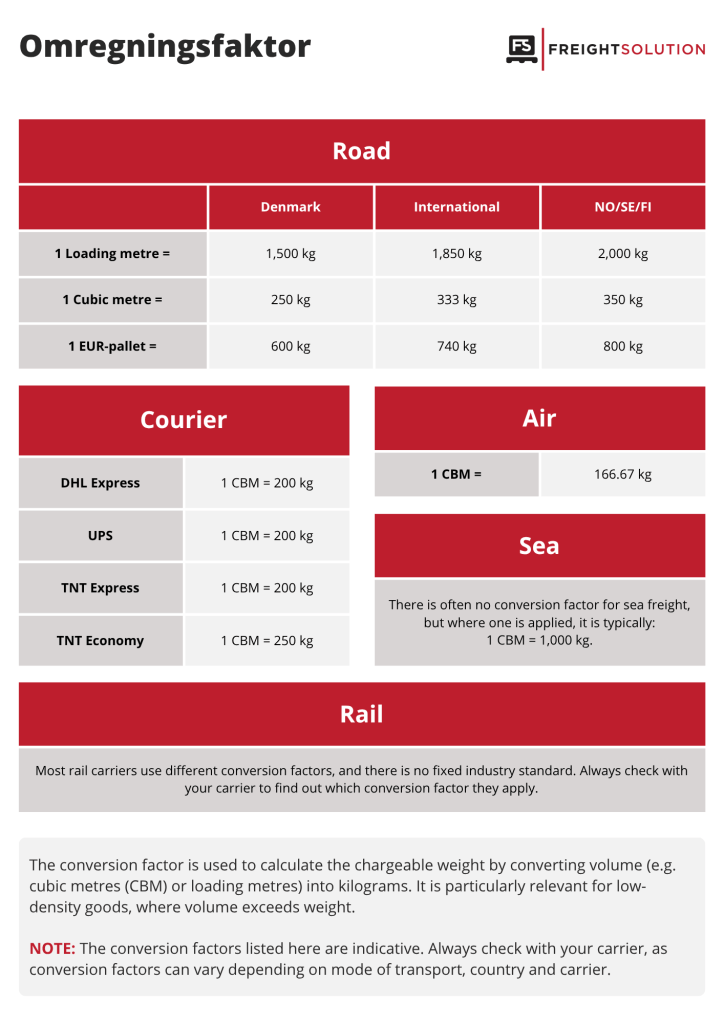
You can also download the overview as a PDF:
And always remember to check with your carrier— as mentioned, some use their own specific conversion factors. The ones listed here are the most commonly used across the industry.
If you have any questions, don't hesitate to reach out!
How to use conversion factors to calculate chargeable weight
Conversion factors are used to calculate volumetric weight — also known as chargeable weight. This is the weight, or volume equivalent, that you actually pay the carrier for.
Every mode of transport has limits on both the space and weight available for cargo. To make the most of that capacity, carriers compare the actual weight of your goods against their volumetric weight — and you pay for whichever is higher.
Read more and see a calculation example in our post on chargeable weight.
FAQ
What is a conversion factor?
A conversion factor converts volume — such as cubic metres or loading metres — into weight, so that transport costs can be calculated. It indicates how many kilograms correspond to one cubic metre (CBM) or loading metre (LDM).
Why are conversion factors important?
Conversion factors are especially important for low-density goods, where volume exceeds weight. They directly affect transport costs and can account for a difference of more than 5%.
Do conversion factors vary between modes of transport?
Yes — conversion factors differ by both mode of transport and carrier. Always check with your carrier to confirm which factor they use.
What is the conversion factor for road transport?
For road transport, the conversion factor varies by region:
- Loading metres: Typically between 1,500 kg and 2,000 kg depending on the market
- National transport: Typically 1 CBM = 250–333 kg
- International transport: Typically 1 CBM = 333–350 kg
What is the difference between actual weight and volumetric weight?
Actual weight is the physical weight of your goods in kilograms. Volumetric weight — also called chargeable weight— is calculated using a conversion factor and represents the "weight" the carrier bills for. You pay for whichever value is higher.