

Read in

Table of contents
When it comes to transport and logistics, there are plenty of factors to consider if you want an efficient and cost-effective shipping process.
One of them is the loading metre — also known as LDM — a unit that plays a central role in planning and pricing freight transport.
But what exactly is a loading metre, and how do you calculate it? Let's get into it.
What is a loading metre?
A loading metre (LDM) is a unit of measurement used to calculate the floor space that goods occupy inside a truck.
Specifically, it measures how much of the truck's length is taken up by a given shipment.
This makes it an essential unit for planning how much cargo can fit in a single trip.
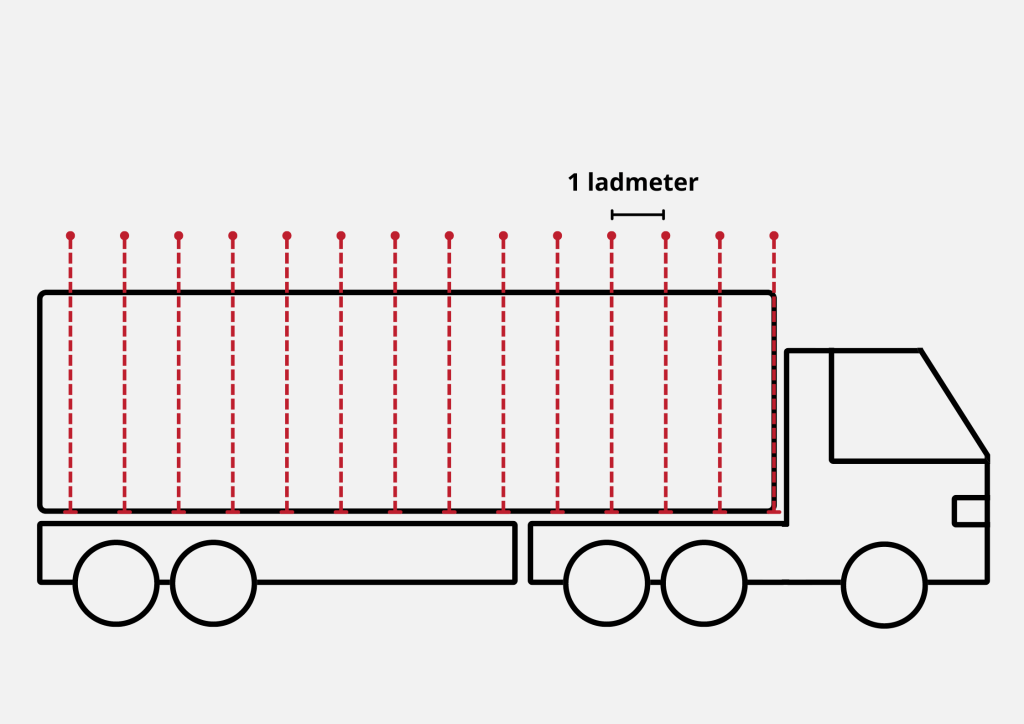
One loading metre equals one metre of the truck's length.Since a standard trailer is 13.6 metres long, a full truck can hold a maximum of 13.6 LDM.
A simple way to picture it: imagine slicing a truck like a loaf of bread, where each slice is exactly one metre thick. Each slice is one loading metre. See the illustration below.
How do you calculate loading metres?
Since loading metres measure floor space in a trailer, the formula is based on the length and width of your goods.
Here's a step-by-step guide:
- Measure the length and width of your goods — in metres.
- Apply the LDM formula — multiply the length (m) by the width (m), then divide by 2.4. The 2.4 figure represents the standard internal width of a truck in metres.
See the formula below.

Example
Our shipment has the following dimensions:
- Length = 1.2 metres
- Width = 0.8 metres

In this example, the goods take up 0.4 loading metres.
Why do loading metres matter?
Loading metres are a practical tool that helps carriers optimise how they use trailer space and price their services accurately.
By knowing exactly how many LDM a shipment requires, carriers can plan truck loading more efficiently, ensure goods are transported safely and stably, and offer more accurate pricing.
Getting loading metres right also helps reduce wasted space — which means fewer trips, lower fuel costs and a smaller environmental footprint.
Loading metres are especially relevant when shipping bulky or oversized goods..
With LDM-based pricing, you only pay for the floor space your goods actually occupy — not for empty air above them.
What to watch out for with loading metre billing
Not all carriers charge for loading metres the same way — and it's worth knowing the difference before you get an invoice.
Some carriers use practical LDM billing, which can include charges for any empty or wasted space around your goods. This is an important detail to clarify with your freight forwarder upfront.
In some cases, billing practices can even vary between departments within the same company — so it's always worth double-checking.
If you're unsure, feel free to reach out to us. We're happy to help, free of charge.
Frequently asked questions about loading metres
What is a loading metre?
A loading metre (LDM) is a unit of measurement used to calculate how much floor space goods take up inside a truck. One loading metre equals one metre of the truck's length.
How do you calculate loading metres?
Measure the length and width of your goods in metres, then multiply them together and divide by 2.4 — the standard internal width of a truck. The result is the number of loading metres your shipment requires.
How many loading metres does a standard truck have?
A standard trailer is 13.6 metres long, which means it has a maximum capacity of 13.6 LDM.
Why do loading metres matter?
Loading metres help carriers optimise how trailer space is used, plan loading efficiently, ensure safe transport and price their services accurately.
Getting loading metres right also reduces wasted space, leading to fewer trips, lower fuel costs and a smaller environmental impact.
What should I be aware of when it comes to LDM billing?
Carriers can differ in how they bill for loading metres — some use practical billing, which may include charges for empty space around your goods.
Always clarify this with your freight forwarder, as practices can vary even between departments within the same company.
Sørg for at afstemme dette med din speditør, da der kan være forskelle internt i samme virksomhed.